Is sourdough bread healthy?
It’s a question many people ask as sourdough has become increasingly popular. Its long fermentation process gives it a distinctive flavor and texture, but it may also influence digestibility, nutrient availability, and blood sugar response. In this article, we’ll look at what current research says—and then I’ll show you how to make homemade sourdough bread yourself.
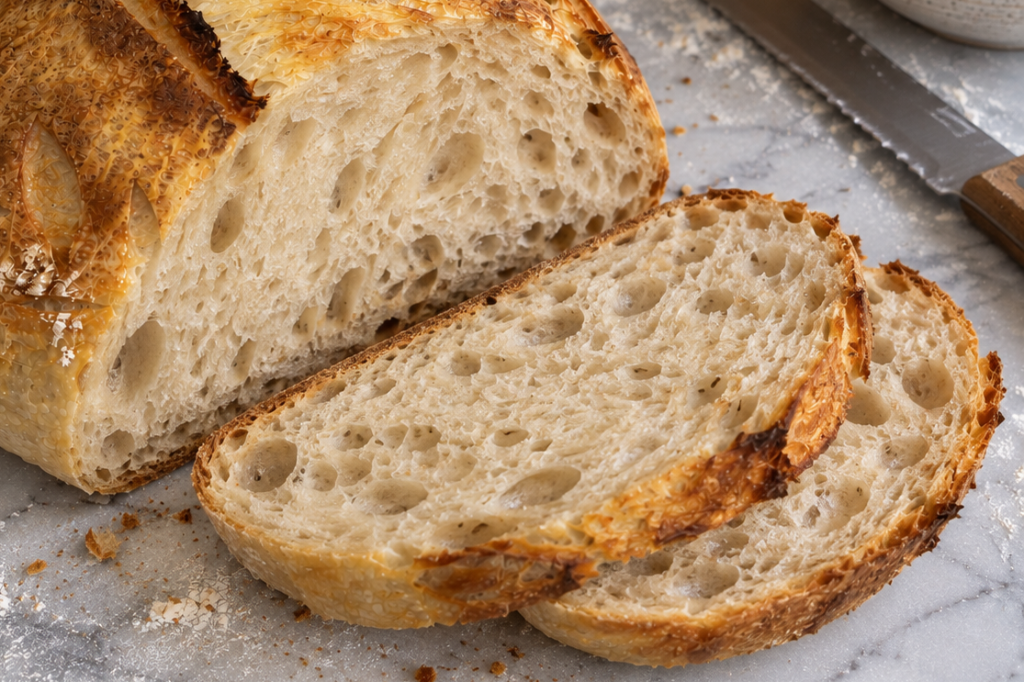
Sourdough is made using a culture of wild yeast and lactic acid bacteria, usually grown from flour and water. Its longer fermentation process can change several characteristics of bread, including its flavor, aroma, texture, shelf life, and some components of the dough.
But that doesn’t mean every loaf of sourdough is automatically healthier.
The type of flour, ingredients, fermentation conditions, fiber content, portion size, and—most importantly—your overall eating pattern all matter.
In this article, we’ll look at what sourdough fermentation actually does, its potential nutritional benefits, what science can and cannot tell us, and how to make a beautiful homemade sourdough loaf yourself.
What Is Sourdough Bread?
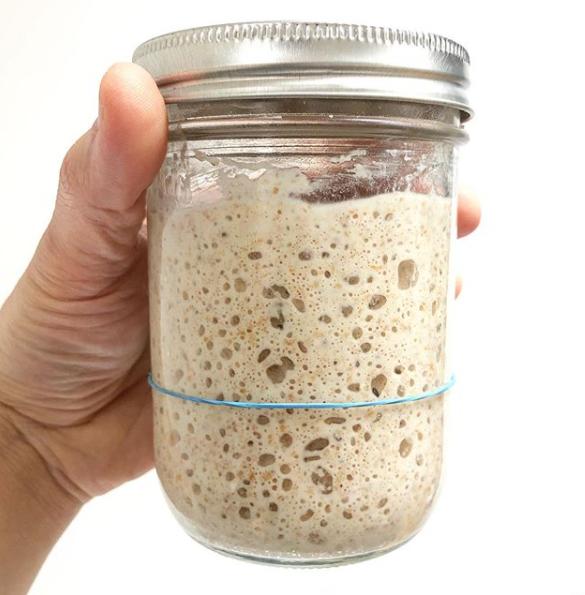
Sourdough bread is made using a natural starter—also called a sourdough starter, levain, or mother dough—cultivated primarily from flour and water.
The starter contains a community of microorganisms, including wild yeasts and lactic acid bacteria.
During fermentation, these microorganisms metabolize components in the dough and produce compounds including organic acids. This process contributes to sourdough’s characteristic aroma, slightly tangy flavor, texture, and keeping qualities.
Fermentation can also modify certain components of the flour. However, the results depend on factors such as the flour, microorganisms present, temperature, fermentation time, and baking method.
That means two loaves labeled “sourdough” may not have identical nutritional characteristics.
A Special Memory From My Childhood
When I was a child in Brazil, my mother received a portion of a natural starter from someone. We used it to make something we called Pão de Cristo, or “Christ Bread.”
I remember the whole process of caring for the starter, feeding it, and waiting until it was ready to make bread.
As the starter grew, part of it would be shared with friends or neighbors so they could continue the process in their own homes. It was almost like a chain passed from one kitchen to another.
One little memory has stayed with me all these years: my mother would even place a small piece of that dough near the rice. Those little family traditions have a way of staying with us.
So when sourdough became incredibly popular again, I remember thinking:
“But this isn’t really new!”
For me, sourdough isn’t just a modern food trend. It takes me back to my mother’s kitchen.
And perhaps that’s one of the things I love most about food. Food isn’t made only of nutrients.
Food is also memory, culture, family, and love.
So, Is Sourdough Bread Healthier?
The most accurate answer is:
It depends.
Research has investigated potential effects of sourdough fermentation on things such as blood glucose response, digestibility, and the availability of certain nutrients.
However, current evidence doesn’t allow us to say that every sourdough bread is automatically healthier than every bread made with commercial yeast.
Imagine comparing a sourdough loaf made primarily from refined white flour with a high-fiber whole-grain bread made with commercial yeast.
Knowing only which type of fermentation was used isn’t enough to tell us which bread has the better nutritional profile.
We have to look at the food as a whole.
1. It May Affect Blood Sugar Response
One area researchers have studied is whether sourdough fermentation changes the blood glucose response after eating bread.
Some studies have found a lower post-meal glucose response with certain sourdough breads compared with some control breads.
But this doesn’t mean all sourdough bread has a low glycemic index or will always produce a lower blood sugar response.
Research findings remain inconsistent. The type of flour, fiber content, structure of the bread, fermentation process, and other factors can all influence the result.
If you need to manage your blood sugar, sourdough shouldn’t be treated as an unlimited food simply because it’s naturally fermented.
2. Fermentation May Affect Mineral Availability
Grains naturally contain phytate, a compound that can bind to certain minerals.
Fermentation conditions may contribute to changes in phytate and therefore potentially influence the availability of some minerals in bread.
That still doesn’t mean every sourdough loaf is automatically “more nutritious.”
The flour, ingredients, and production method continue to matter.
3. Fermentation Changes Components of Wheat
Fermentation can modify or partially break down various components naturally present in grains.
These changes have generated scientific interest, particularly in research involving digestibility and tolerance.
However, there’s an important distinction between showing that something changes chemically during fermentation and demonstrating a meaningful health benefit in people.
That’s why I would be careful with broad claims such as:
“Sourdough is easier for everyone to digest.”
Some people may notice differences between breads, but we can’t generalize that experience to everyone.
4. Flavor and Aroma
Not every benefit has to be a health claim!
Fermentation produces compounds that contribute to sourdough’s distinctive flavor and aroma.
For me, this is one of the most interesting parts.
Sourdough can develop a wonderfully complex flavor with that characteristic tanginess, which varies depending on your starter and fermentation process.
Does Sourdough Bread Have Gluten?
Yes—if it’s made with wheat or another gluten-containing grain.
This is very important.
Fermentation can modify certain components of flour, but that doesn’t make traditional wheat sourdough bread gluten-free.
Sourdough and gluten-free are not the same thing.
People with celiac disease need to follow appropriate guidance for a strictly gluten-free diet and should not assume traditional wheat sourdough is safe simply because it underwent natural fermentation.
There are sourdough recipes specifically formulated with gluten-free ingredients, but those are different from traditional wheat sourdough bread.
Does Sourdough Bread Make You Gain Weight?
No single food determines weight gain or weight loss by itself.
Sourdough still provides calories and carbohydrates, and its calorie content depends on the recipe and ingredients.
So it isn’t a bread that somehow “doesn’t make you gain weight.”
For weight management, factors such as portion size, frequency, the composition of your meals, and your overall dietary pattern matter.
A slice of bread can absolutely fit into a balanced diet.
Context matters more than labeling an individual food as “good” or “bad.”
Sourdough vs. Regular Bread: What’s the Difference?
One of the main differences is the fermentation process.
Commercially yeasted bread uses selected yeast to ferment the dough and make it rise.
A sourdough starter contains a community of yeasts and bacteria, and sourdough bread often goes through a longer fermentation process.
Depending on the conditions, this can produce differences in flavor, aroma, acidity, texture, shelf life, and some components of the dough.
But the fermentation method shouldn’t be the only thing you consider when choosing bread.
How to Choose a Good Sourdough Bread
Don’t choose bread solely because the package says “sourdough.”
Look at the whole product.
Read the ingredient list and see which flour is listed first. When appropriate, consider whole-grain content, fiber, sodium, added sugars, and other ingredients.
Remember:
“Sourdough” isn’t an automatic seal of healthfulness.
Tools I Use to Make Sourdough Bread
You don’t need a lot of special equipment to make sourdough bread, but a few basic tools can make the process easier and more consistent. These are the tools I use and recommend for making homemade sourdough.
Digital kitchen scale, Dutch oven, banneton/proofing basket, bread lame, and optionally parchment paper.
Affiliate disclosure: This post contains affiliate links. If you purchase through one of these links, I may earn a small commission at no additional cost to you.
Now Let’s Make Sourdough!
Now that we’ve talked about the science, let’s get to the delicious part: making bread.
Sourdough requires a little more patience than bread made with commercial yeast, but that can also make the process incredibly rewarding.
And here’s one of my most important tips:
Don’t watch only the clock. Learn to watch your dough.
Room temperature, flour, starter activity, and even the conditions in your kitchen can dramatically change how long each stage takes.
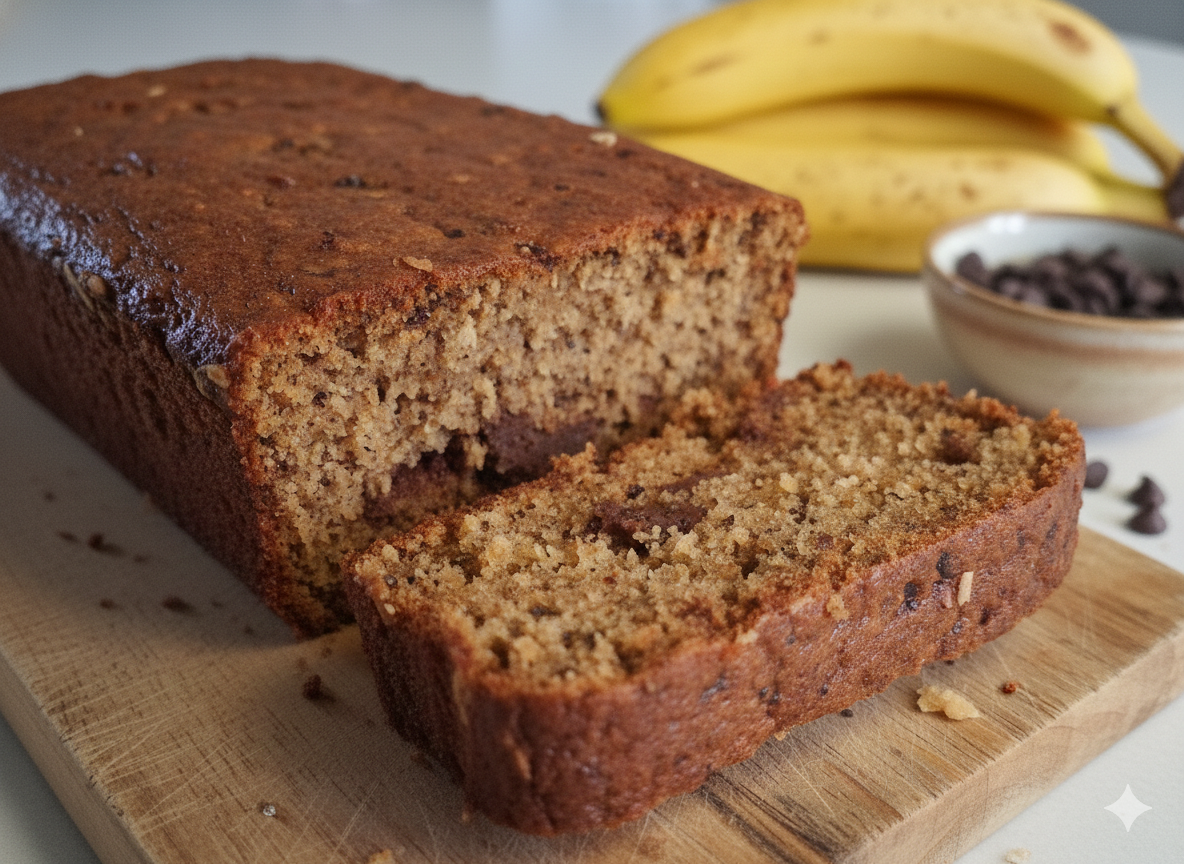
If you enjoy baking at home, you may also like my Sugar-Free Banana Bread, an easy wheat-free recipe.

Homemade Sourdough Bread
Ingredients
Equipment
Method
- Mix the flour and water. Combine 500 g of flour with approximately 300 g of water, reserving the remaining 20 g. Mix until there are no large areas of dry flour. Cover and rest for approximately 30 minutes.
- Add the sourdough starterAdd 100 g of active sourdough starter. Mix thoroughly until incorporated into the dough.
- Add the saltDissolve 10 g of salt in the remaining 20 g of water. Add it to the dough and mix until incorporated. Cover and rest for approximately 30 minutes.
- Stretch and foldWith lightly wet hands, stretch one side of the dough upward and fold it over the center. Rotate the bowl and repeat on all sides. Wait approximately 30 minutes and repeat. Complete 3–4 rounds.
- Bulk fermentationLeave the dough covered at room temperature until it has noticeably increased in volume and looks lighter and airier, with small bubbles and a slightly domed surface. Watch the dough rather than relying only on the clock.
- Pre-shape and shapeTransfer the dough gently to a clean work surface. Pre-shape into a round and rest for 15–30 minutes. Complete the final shaping, creating gentle tension across the surface.
- Final proofPlace the dough into a banneton or a bowl lined with a lightly floured clean kitchen towel. Cover and refrigerate overnight for approximately 8–14 hours.
- Preheat the ovenPlace the Dutch oven and lid inside the oven. Preheat to 450°F (230°C) for 30–45 minutes.
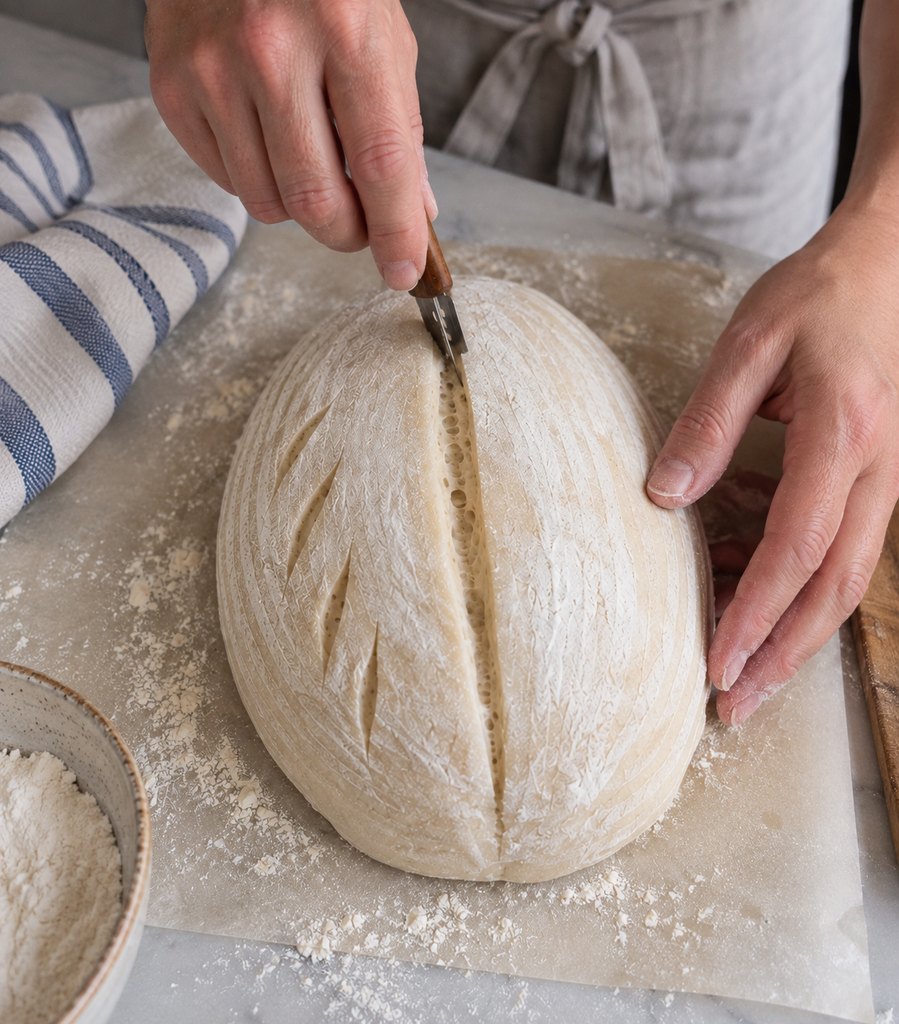
- Score the doughTransfer the cold dough onto parchment paper. Score the surface with a bread lame or very sharp knife.
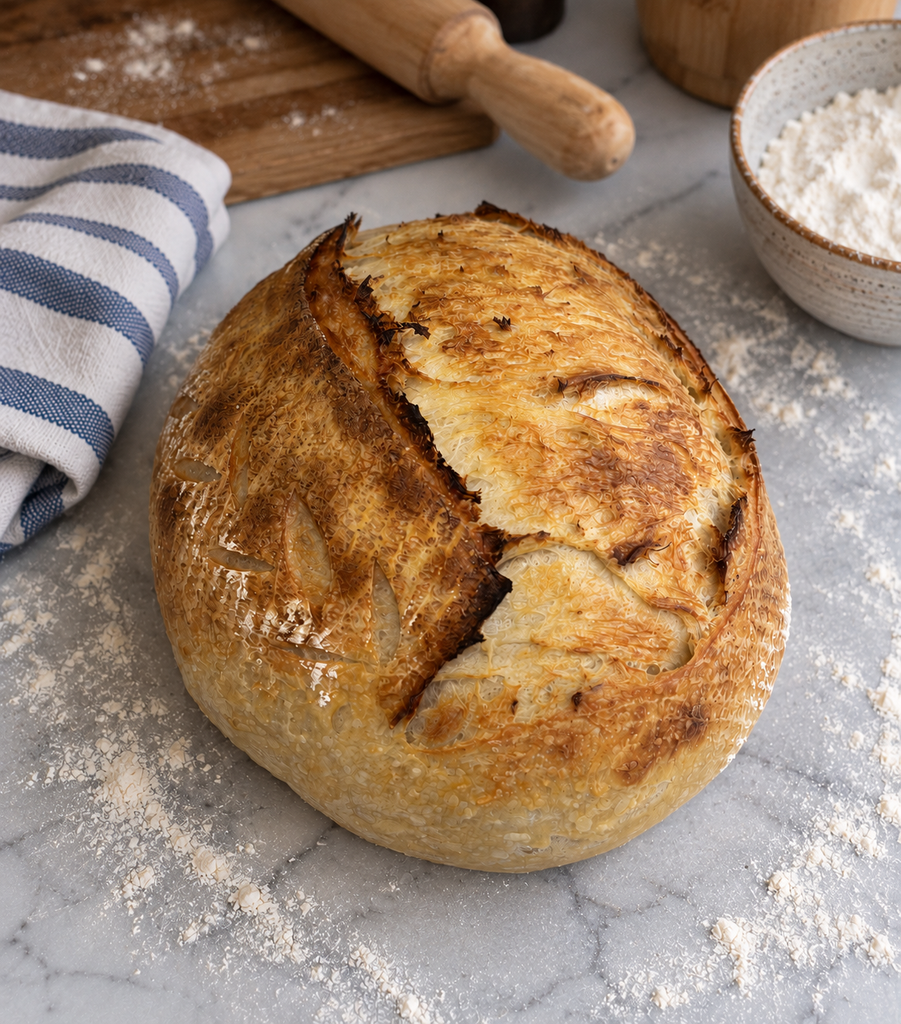
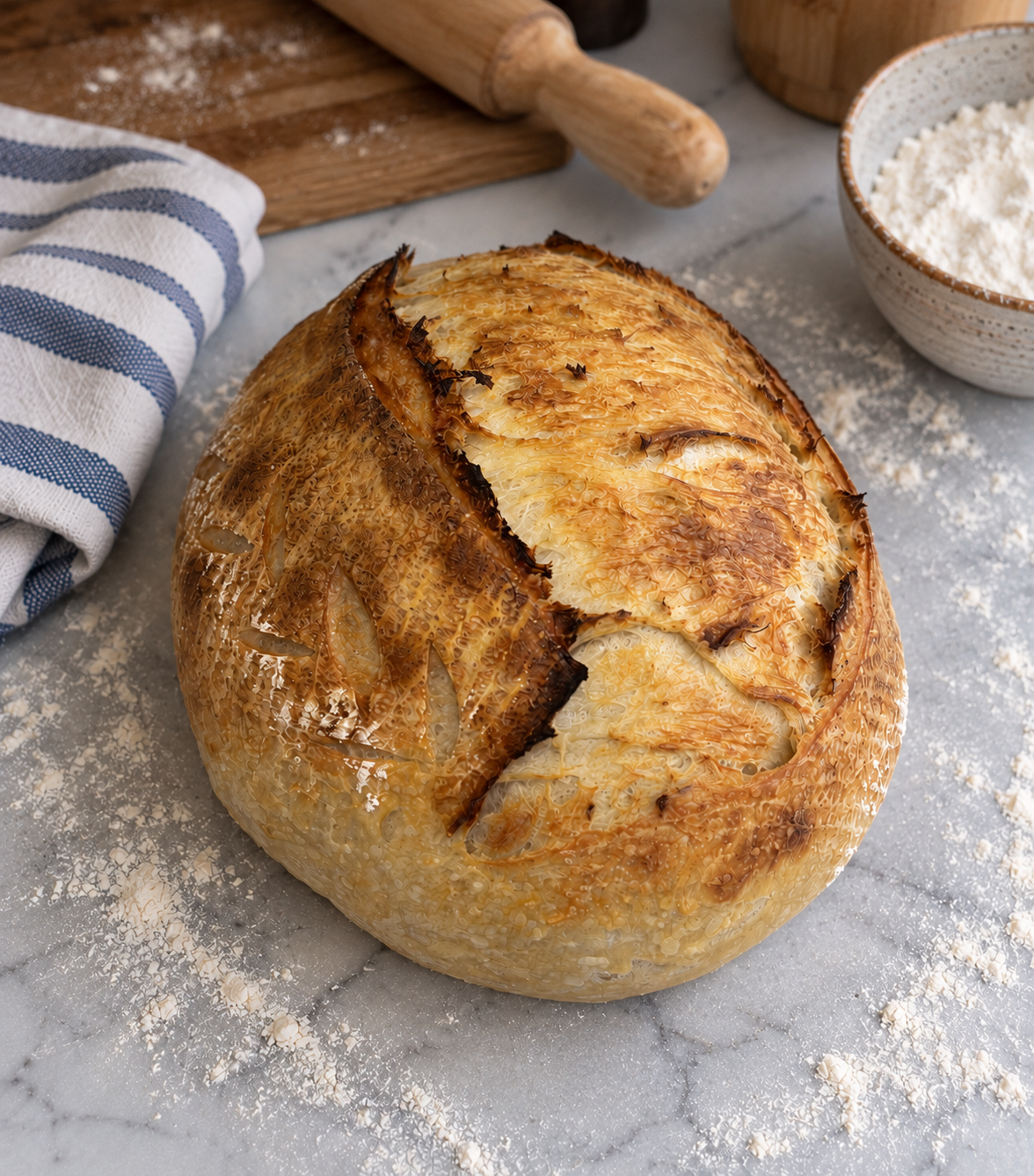
- BakeCarefully place the dough into the hot Dutch oven. Cover and bake at 450°F (230°C) for approximately 20 minutes. Remove the lid, reduce the temperature to 425°F (220°C), and bake for another 20–25 minutes, or until deeply golden.
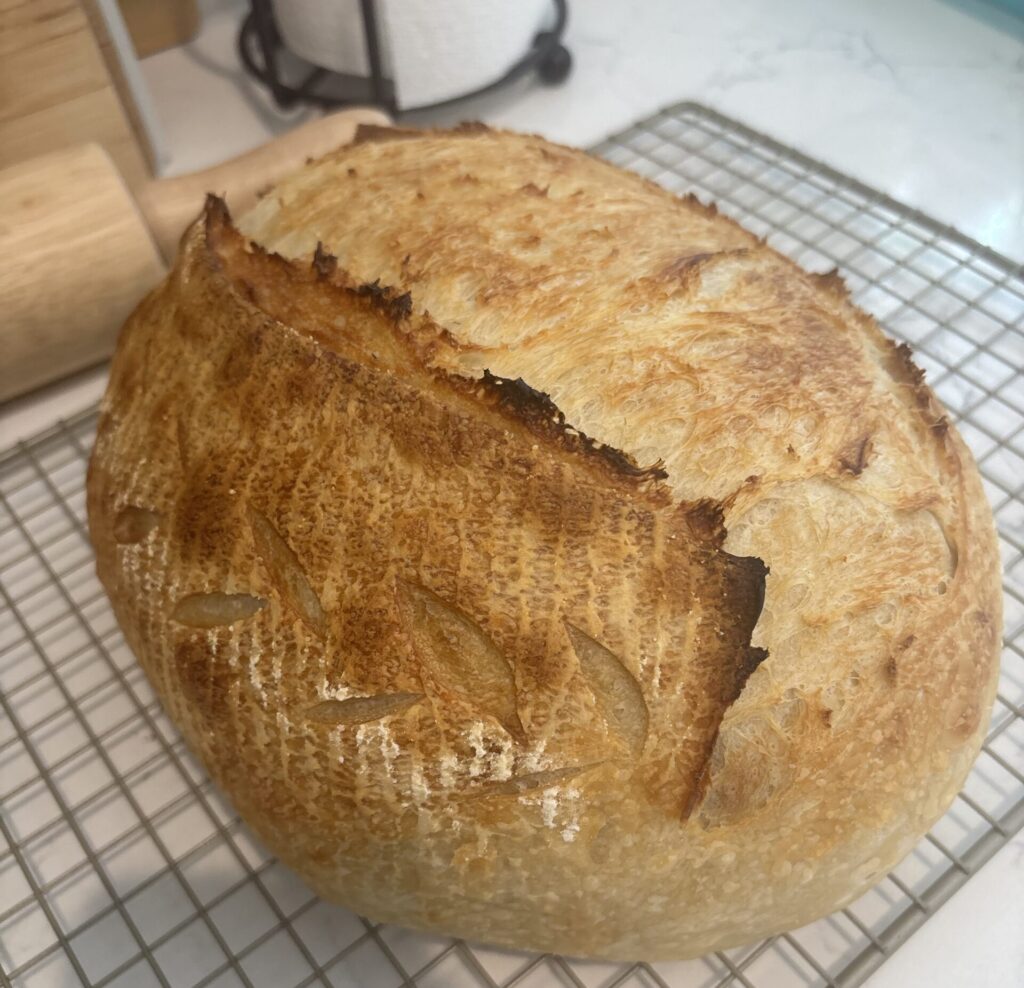
- CoolTransfer the bread to a cooling rack and allow it to cool for at least 1–2 hours before slicing. This is a very important step because the crumb continues to set as the loaf cools.
Notes
Daisy’s Tips for Better Sourdough
Use a kitchen scale. Baking by weight gives you much more consistency than measuring flour and water in cups.
Watch your dough, not just the clock. This may be the most important advice in the entire recipe. Temperature, flour, starter activity, and your kitchen environment can all affect fermentation time.
Don’t add too much flour. Sticky dough doesn’t necessarily mean something has gone wrong.
Start simple. Master one basic loaf before making lots of modifications.
Take care of your starter. An active, bubbly starter makes a big difference.
Keep notes. Write down the temperature, fermentation time, flour you used, and your results. Eventually, you’ll learn how sourdough behaves in your own kitchen.
And most importantly, don’t get discouraged if your first loaf isn’t perfect.
Sourdough is a learning process—and every loaf teaches you something.
Can I Use Whole-Wheat Flour?
Yes.
Whole-wheat flour can change water absorption, dough structure, flavor, and fermentation.
If you’re a beginner, try replacing about 10–20% of the white flour with whole-wheat flour.
As you become more comfortable with the process, you can experiment with higher percentages.
How Should I Store Sourdough Bread?
Let the loaf cool completely before storing it.
For longer storage, I like to slice and freeze it. That way, you can take out only the slices you need and toast or warm them as desired.
Avoid storing the loaf while it’s still warm because trapped moisture can negatively affect its texture.
Sourdough Troubleshooting
Why Is My Sourdough Flat and Dense?
Your starter may not have been active enough, the dough may have been under- or overfermented, or it may not have developed enough structure.
Why Is My Sourdough Dough So Sticky?
This can be related to hydration and the type of flour you’re using. Don’t immediately try to fix sticky dough by adding large amounts of flour.
Why Didn’t My Sourdough Rise in the Oven?
Possible causes include overfermentation, a sluggish starter, or shaping problems.
Why Is My Sourdough Gummy Inside?
The loaf may need additional baking time—or you may have cut it while it was still too warm. Remember that the crumb continues to set as the loaf cools.
Why Is My Sourdough Too Sour?
Acidity varies with your starter and fermentation conditions. Experiment with fermentation time and temperature on your next loaf.
Remember: every loaf teaches you something that helps with the next one.
Don’t Have a Sourdough Starter Yet?
If you’re reading this thinking:
“Daisy, I don’t even have a starter!”
Don’t worry.
You can create your own sourdough starter with essentially just flour and water.
I prefer to cover this separately because starting, feeding, maintaining, and reviving a sourdough starter deserves its own beginner-friendly guide.
Coming soon: How to Make a Sourdough Starter From Scratch — A Step-by-Step Guide for Beginners.
And here’s something I find especially beautiful about sourdough.
Once your starter becomes active and you have more than you need, you can share some with someone else.
That’s exactly how that starter reached my mother all those years ago.
Maybe that’s one of the loveliest sourdough traditions of all: a starter can travel from one kitchen to another, creating new stories along the way.
Is Sourdough Worth Adding to Your Diet?
For many people, sourdough bread can absolutely be part of a balanced eating pattern.
It has interesting culinary characteristics, and fermentation genuinely changes various components of the dough.
Scientists continue to investigate whether some of those changes translate into meaningful health benefits.
But current evidence doesn’t justify turning sourdough into a “superfood” or assuming it’s always superior to commercially yeasted bread.
When choosing bread, look at the whole picture: flour, fiber, ingredients, sodium, portion size, and the rest of your diet.
And there’s something else no nutrition label can measure.
For me, making sourdough also means waiting, caring, sharing, and remembering.
Whenever I think of that starter passing through my mother’s hands, then to neighbors and other families, I’m reminded that food can nourish much more than our bodies.
It can nourish our memories, too.
Rather than focusing on a single food, I prefer looking at the overall eating pattern. If you’re interested in different approaches to balanced eating, you can also read my guide to the best diets for a healthy lifestyle.
Frequently Asked Questions About Sourdough Bread
Is sourdough bread healthier than regular bread?
Not necessarily. Fermentation can change different components of bread, but we can’t say that every sourdough loaf is healthier than every conventional loaf. Flour, fiber, ingredients, portion size, and preparation methods all matter.
Is sourdough bread lower in calories?
Not necessarily. The calorie content depends on the ingredients and quantities used.
Does sourdough bread contain gluten?
Traditional sourdough made with wheat contains gluten. Natural fermentation does not automatically make bread gluten-free.
Can someone with celiac disease eat sourdough bread?
Traditional wheat sourdough should not be considered gluten-free. People with celiac disease need foods that meet appropriate gluten-free requirements.
Is sourdough better for people with diabetes?
We can’t generalize. Some studies have reported differences in post-meal blood glucose responses with certain sourdough breads, but results vary depending on the bread and study conditions.
People managing diabetes should consider the type and amount of carbohydrate within their individual eating plan rather than assuming sourdough can be eaten without consideration of portion size.
Is sourdough the same as levain?
They’re closely related terms. In breadmaking, levain commonly refers to a portion of naturally fermented starter prepared for use in a particular batch of bread.
Final Thoughts
So, is sourdough bread healthy? For many people, it can certainly be part of a balanced eating pattern, but the answer depends on the ingredients, type of flour, portion size, and the rest of the diet.
Sourdough bread is fascinating from both a culinary and scientific perspective.
Fermentation changes components of the dough, and researchers continue studying possible effects involving blood glucose response, nutrient availability, and tolerance.
At the same time, we need to distinguish between changes observed during fermentation and health benefits actually demonstrated in humans.
Rather than labeling sourdough “good” and conventional bread “bad,” I prefer looking at the quality of the food and the overall diet.
And if you enjoy baking, homemade sourdough offers something else entirely: watching something living grow, learning patience, and sharing what you’ve made with people you love.
References & Sources
The information in this article was prepared based on the available scientific literature on sourdough fermentation and its potential nutritional and metabolic effects.
Ribet L, Dessalles R, Lesens C, Brusselaers N, Durand-Dubief M. Nutritional benefits of sourdoughs: A systematic review. Advances in Nutrition. 2023;14(1):22–29. DOI: 10.1016/j.advnut.2022.10.003.
Rolim ME, Fortes MI, Von Frankenberg A, Duarte CK. Consumption of sourdough bread and changes in the glycemic control and satiety: A systematic review. Critical Reviews in Food Science and Nutrition. 2024;64(3):801–816. DOI: 10.1080/10408398.2022.2108756.
D’Amico V, Gänzle M, Call L, Zwirzitz B, Grausgruber H, D’Amico S, Brouns F. Does sourdough bread provide clinically relevant health benefits? Frontiers in Nutrition. 2023;10:1230043. DOI: 10.3389/fnut.2023.1230043.
Starowicz M, Domínguez-Soberanes J, Garcia-Gutierrez E, Arslan-Tontul S, Burton-Pimentel KJ, Vidović B, et al. Effects of sourdough and yeast fermented breads consumption on glycaemia in healthy populations: a systematic review. Frontiers in Nutrition. 2026;13:1910648. DOI: 10.3389/fnut.2026.1910648.
Celiac Disease Foundation. Sources of Gluten.